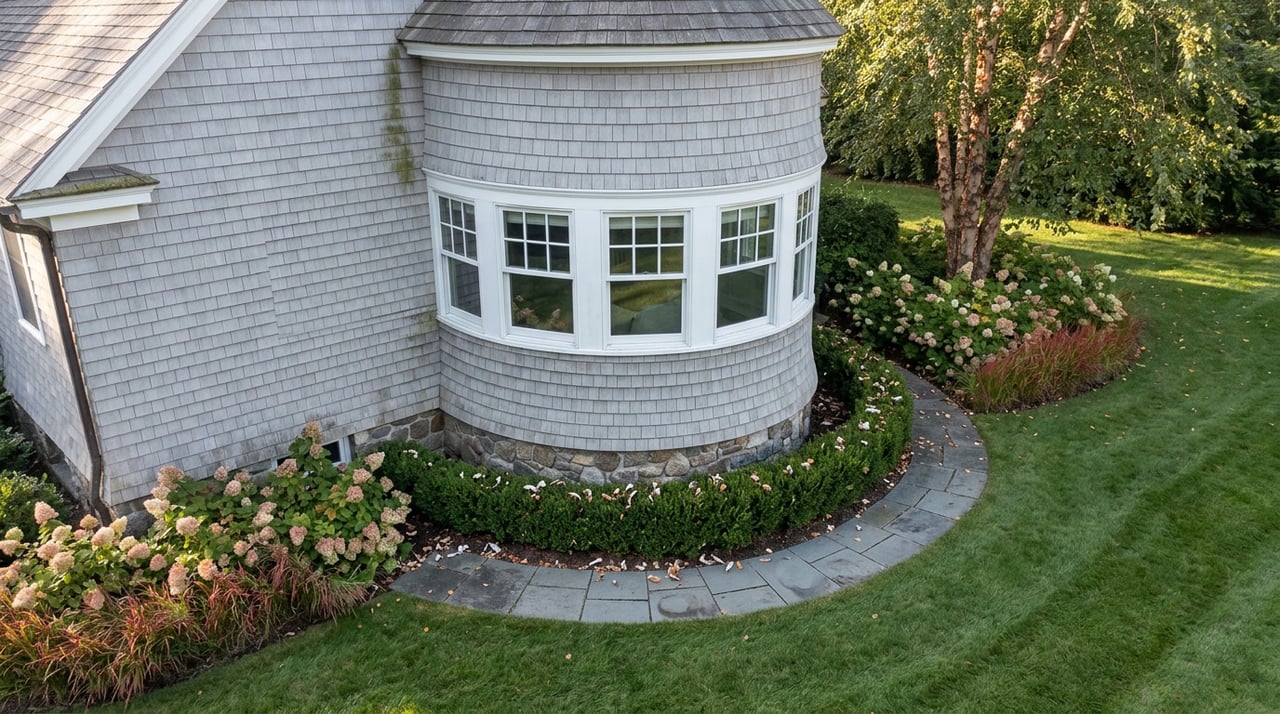
In Scarborough, One Median Price Is Hiding Two Different Housing Markets
August 27, 2026
August 27, 2026
This week, an oceanfront estate near Prouts Neck is asking just under four million dollars. A few miles inland, in Dunstan, a well kept colonial is listed for well under six hundred thousand. Both addresses say Scarborough, Maine. Both would show up under the same town-wide median if you searched a portal. And that median would tell you almost nothing useful about either one.
Buyers comparing Scarborough to other Southern Maine towns tend to start with a single number: the town's median sale price. It is a reasonable instinct. It is also the wrong tool for this particular town, because Scarborough is not one housing market wearing one zip code. It is closer to four or five distinct micro-markets stitched together by a shared tax rate and a shared school department, each with its own price logic, its own pace of turnover, and in one important respect, its own tax exposure. Understanding that difference matters more than the headline median, especially for anyone weighing a beach cottage against an inland colonial with the same number on the sign.
Start with the part that catches people off guard after closing, not before it.
In 2024, the Town of Scarborough completed a town-wide property revaluation, the first since 2019. The reason wasn't optional. Prior to the reval, the town's own assessment audits showed Scarborough's assessed values had drifted to just 72 percent of true market value in 2022 and 63 percent in 2023, well below the ratio Maine law requires for a municipality to keep its certified status with the state. When the town's assessor presented early estimates to the Town Council that spring, the numbers were stark: residential property owners could expect an average 53 percent increase in assessed value, notably higher than the 43 percent increase projected for commercial property. A home assessed at $400,000 before the reval might land closer to $612,000 after it, purely to reflect what the market had already been paying.
The reval is done now. Scarborough is back to a certified 100 percent assessment ratio, and the current mill rate sits at $11.33 per $1,000 of value, set for the fiscal year running through mid-2026. The next town-wide revaluation isn't scheduled until 2029. That means the tax bill attached to any Scarborough listing right now reflects a genuinely current snapshot of value, not a stale one, which is unusual and worth knowing if you're used to shopping in a town where assessments lag the market by years.
The town's estimates didn't break waterfront out from inland, but a reval works the same way everywhere: the property that had drifted furthest from its old assessed number absorbs the largest correction. Scarborough's waterfront, concentrated in Pine Point, Higgins Beach, and Prouts Neck, had appreciated the most in the years since 2019, which means it's a reasonable bet that those neighborhoods felt the 2024 reset harder than inland Scarborough did. Two buyers who closed on similarly priced homes in different neighborhoods this year may be carrying different tax trajectories, not because of what they paid but because of how far their neighborhood's assessment had to travel to catch up.
Here is the detail that rarely comes up until a buyer is already comparing two closing statements.
Maine's homestead exemption reduces the taxable value of a primary residence by $25,000. On a Scarborough home valued at $500,000, that exemption is the difference between an annual bill of $5,665 and one of $5,381.75, a savings of $283.25 under the current mill rate. It is a modest number on its own. It becomes a structural difference when you consider who qualifies for it.
The exemption applies only to a primary, owner-occupied residence. It does not apply to second homes, seasonal cottages, or investment property, full stop. And Scarborough's beach neighborhoods carry an unusually high share of exactly that kind of ownership. Housing data for the Higgins Beach and Prouts Neck area shows a real estate vacancy rate around 21 percent, well above what you'd see in a typical year-round suburb, with roughly 17 percent of housing seasonally occupied. A meaningful share of the homes along that stretch simply aren't anyone's primary residence for tax purposes, which means their owners pay the full, unexempted rate on their full assessed value every year, regardless of how modest the cottage is.
Put those two mechanisms together and you get the real story behind Scarborough's median price. It isn't one market absorbing one uniform correction. It's a fast-turning, mortgage-financed, largely owner-occupied inland market layered against a slower-turning, often cash-purchased, frequently inherited or seasonally-held coastal strip, and the two behave differently at tax time as well as at closing.
The price bands make more sense once you see them through that lens.
| Area | Typical Price Range | What Shapes It |
|---|---|---|
| Pine Point | Roughly $550,000 for an older cottage up to $1.5 million or more for a modern oceanfront rebuild | A working clamming village turned beach neighborhood, with a genuine year-round population mixed among summer cottages |
| Higgins Beach | Roughly $480,000 to $1.3 million depending on proximity and view | Small, tightly held enclave with a strong neighborhood association and homes that often pass down through the same family for decades |
| Prouts Neck | Scarborough's highest-valued waterfront, with estate-level listings well into seven figures | A private peninsula with deep ties to American art history and a historic country club that shape what can be built and where |
| Black Point and Blue Point | A step below the beach-direct neighborhoods they border | Black Point runs along Scarborough Beach State Park; Blue Point sits nearer the marsh, with a mix of older homes and marsh or ocean views |
| Dunstan, Pleasant Hill, and Oak Hill | Homes starting well under $400,000, with established family neighborhoods and Scarborough's commercial hub along Route 1 | Inland Scarborough, largely owner-occupied, financed the way most suburban home purchases are financed |
There's a fifth number worth adding to that table, one that doesn't come with a fixed address. Homes with a view of or direct access to the Scarborough Marsh, the largest salt marsh in Maine, tend to command a premium of roughly $100,000 to $200,000 over comparable inland homes without it. That's real money attached to a landscape feature, not a structure, and it's the kind of premium that only shows up once you're comparing two otherwise similar houses a half mile apart.
None of this is just price trivia. A buyer shopping Higgins Beach against Dunstan isn't really choosing between two homes at similar price points. They're choosing between two different transaction environments: one where inventory is thin, turnover is slow, and a fair number of sellers are moving a family cottage rather than a primary residence, and one that behaves like most financed suburban markets in Greater Portland.
Zoom out and the contrast gets sharper. In July 2026, the statewide median sale price for an existing single-family home reached $427,000, according to Maine Listings and the Maine Association of Realtors, up 1.67 percent from $420,000 the year before. Over the May through July 2026 rolling quarter, Cumberland County, the county that includes Scarborough, Portland, and Cape Elizabeth, posted a median of $618,000.
Scarborough's inland neighborhoods sit close to that county figure. Its coastal necklace sits well above it, in some cases by a multiple of two or three. That gap is exactly what a single town-wide median flattens out, and it's why a buyer who anchors on "Scarborough's median price" without asking which Scarborough they mean can end up shopping the wrong comparables entirely.
If you're weighing a move here, the more useful question isn't "what's Scarborough's median price" but "which of these markets am I actually shopping in, and what does that mean for my tax bill five years from now." A few things worth asking before you get attached to a listing:
Those three questions will tell you more about what you're actually buying than any town-wide average.
Scarborough rewards buyers who understand its geography as a set of separate decisions rather than one number to beat. If you'd like to talk through which of these neighborhoods actually fits your budget and your plans, Andi & Elaine at Andi Robinson Homes would be glad to walk through it with you. Request a complimentary market consultation and we'll help you compare the parts of Scarborough that are actually comparable.
Get assistance in determining current property value, crafting a competitive offer, writing and negotiating a contract, and much more. Contact us today.